

Rapid City, South Dakota · Serving Rapid City & the Black Hills
The Black Hills painting calendar
Paint does not know what month it is. It responds to the temperature of the surface it is sitting on, to how close that temperature is to the dew point, and to whether both of those hold for the next two days. In western South Dakota the honest answer to all three is narrower than people expect — and it is different in Custer than it is in Rapid City.
Everything below is built from two kinds of published number: NOAA climate normals and National Weather Service freeze records for this specific corner of the state, and the application limits the coating manufacturers print on their own data sheets. Where a figure could not be traced to a primary source, it was cut rather than rounded off. The sources are listed at the bottom, and you can check every one of them.
Two thermometers set the season. Neither is the one on your porch.
The surface, not the air
A wall in direct sun runs far hotter than the air around it; a shaded north wall runs colder. Manufacturers write their application ranges against the surface temperature and tell you to measure it with an infrared thermometer rather than assume it. The same guidance says to avoid applying in direct sunlight at all — heat drives the solvent off before the film can level, and you get brush marks, lap marks and poor adhesion.
Five degrees above the dew point
The rule the manufacturers publish is to apply only when the surface is more than 5 °F above the dew point. Below that margin, water condenses onto a film that has not closed yet. That is what a blistered, milky finish on an otherwise perfect wall usually turns out to be.
50 °F, for hours
The USDA Forest Products Laboratory puts the latex limit plainly: latex coatings generally require at least 50 °F for several hours after application to properly coalesce. Under that, the film never closes into a film. Oil-based stains are the exception the Laboratory names — those can go down to about 40 °F, which is why the shoulder months are not equally lost to every product.
And it has to hold
Manufacturer guidance commonly asks for conditions to stay in range and above the dew point for roughly 48 hours after application — not for the hour you were on the ladder. A warm afternoon followed by a 38 °F night is not a warm day as far as the coating is concerned.
At Rapid City Regional Airport, the normal overnight low clears 50 °F in exactly 3 months of the year: June, July and August.
The normal daily high clears 50 °F from April through October — 7 months. That is the figure a national “best time to paint” article would quote. The 3-month figure above it is the one that decides whether the film closes overnight.
Month by month, straight off the normals
These are NOAA’s 1991–2020 climate normals for Rapid City Regional Airport. The last column is not an opinion: it is the 50 °F coalescence threshold applied to the two temperature columns. A month is Exterior season when the normal low clears it, Watch the window when only the high does, and Inside work when neither does.
| Month | Normal high | Normal low | Normal rain & melt | What that permits outside |
|---|---|---|---|---|
| January | 36.0 °F | 12.7 °F | 0.31 in | Inside work |
| February | 38.1 °F | 14.0 °F | 0.50 in | Inside work |
| March | 48.2 °F | 22.6 °F | 0.91 in | Inside work |
| April | 56.6 °F | 31.2 °F | 2.08 in | Watch the window |
| May | 66.5 °F | 41.7 °F | 3.45 in | Watch the window |
| June | 77.6 °F | 51.6 °F | 2.87 in | Exterior season |
| July | 86.4 °F | 58.5 °F | 2.28 in | Exterior season |
| August | 85.4 °F | 56.2 °F | 1.59 in | Exterior season |
| September | 76.1 °F | 46.4 °F | 1.22 in | Watch the window |
| October | 60.4 °F | 33.7 °F | 1.41 in | Watch the window |
| November | 47.3 °F | 21.9 °F | 0.47 in | Inside work |
| December | 37.2 °F | 13.9 °F | 0.35 in | Inside work |
Blue in the low column marks a month whose normal overnight low is below freezing. Source: NOAA NCEI monthly climate normals 1991–2020, station USW00024090.
3.45 in
May is the wettest month of the year — nearly three times September’s 1.22 in, the driest month in which exterior work is possible at all.
48%
of the year’s normal precipitation (8.40 of 17.44 in) falls in April, May and June — a quarter of the year carrying half the water.
6
months whose average day crosses 32 °F in both directions: Nov, Dec, Jan, Feb, Mar, Apr. That is the next section.
Six months a year, an average day here crosses freezing twice
From November through April the normal daily high in Rapid City is above 32 °F and the normal daily low is below it. Not on a cold snap — on an average day. That is the textbook definition of a freeze–thaw climate, and it is doing more damage to exterior paint here than sun is.
Chinook winds sharpen it. The National Weather Service describes Black Hills winter days as averaging in the 30s, with chinooks warming temperatures into the 50s and 60s. The most extreme case on record happened in one of these towns: on 22 January 1943 a chinook took Spearfish from −4 °F to 45 °F in two minutes — still the largest two-minute temperature change ever recorded anywhere.
What that does to a coating is mechanical, not chemical. Water that works into a check, a butt joint or a split caulk line during a 45 °F afternoon freezes overnight and expands. Do that a few dozen times a winter and the film is levered off from behind. The Forest Products Laboratory is blunt about which finishes suffer most: film-forming finishes such as paints and solid-color stains “are prone to trap moisture and fail by peeling.”
The practical consequence is unpopular and true. If paint is failing in one place year after year, the paint is not the problem — the water path is. A recoat over it buys a season. Finding where the water gets in buys the repaint.
The season is shorter up in the Hills, and here is by how much
Median freeze dates from the National Weather Service. Half of past years hit the threshold by the date shown.
- Rapid City
- Last spring freeze May 9 · first fall freeze September 26 · first hard freeze October 9140 days between freezes
- Lead
- Last spring freeze May 23 · first fall freeze September 20 · first hard freeze October 1120 days between freezes
- Custer
- Last spring freeze June 4 · first fall freeze September 9 · first hard freeze September 1797 days between freezes
Custer’s freeze-free window is 43 days shorter than Rapid City’s. A quote written against a Rapid City calendar is wrong by six weeks up in the southern Hills.
June looks like the best month and behaves like the worst
June is the first month of the year whose normal overnight low clears the 50 °F line, so on paper it opens the exterior season. It is also the back half of the wettest stretch of the year and the heart of hail season. April, May and June together carry 8.40 of the 17.44 inches Rapid City averages in a year.
The National Weather Service office here does not hedge about the hazard: “Of all the severe hazards, large hail is the one that we experience most often across our area, particularly near and just east of the Black Hills.” And: “Golf ball-sized hail is common during the summer months, while several incidences of baseball-sized or larger hail are likely each year.” Severe weather runs with the majority coming from late May through August.
Eight hours, minimum
Manufacturer guidance for exterior latex is a minimum of about eight hours of dry time before rain when it is above 70 °F. A storm that arrives at four o’clock lands on a film applied at ten.
Then the dew
And the evening is not free either. In the manufacturers’ own words, dew forms on almost everything as soon as the sun sets and seeps into uncured paint. The last coat has to go on early enough to beat both.
So June is a half-day month
Not a lost month — a month where application stops in the early afternoon and the rest of the day is prep. Anyone quoting June exteriors on a full-day production rate is quoting a schedule the weather will not hold to.
Washing is quick. The waiting is the job.
The single most common way a good prep job turns into a failed finish is coating wood that still has water in it. Every published guideline on this is measured in days, not hours.
Two warm, windy days on a deck
The Forest Products Laboratory’s instruction for a deck that has just been cleaned is to “allow at least 2 warm, windy days to dry.” Where mildew has been cleaned off, it says to allow the wood to dry one or two days before refinishing. In August you can get that easily. In April you frequently cannot.
Below 15% moisture content
Manufacturer data sheets for exterior wood stains put a hard ceiling on the substrate: below 15% moisture content is a typical published limit, and it is a number you meter rather than eyeball. Wood that looks dry on the face can be well over it a quarter-inch down.
A day after heavy rain, at least
The manufacturers’ guidance after a heavy rain is a minimum of one day — and the surface still has to be dry when you get there, whatever the calendar says.
And the washer can do damage
Pressure is not prep. The Forest Products Laboratory warns that “aggressive scrubbing with a caustic cleaner or power washing can remove wood from the surface, particularly on softer wood such as western redcedar.” Furred, torn grain drinks finish unevenly and shows every lap.
One wall dries. The other one does not.
“Two warm, windy days” is a property of an elevation, not of a house. A south wall gets them in a week when a shaded north wall and the underside of a deck do not. Washing the whole house on Monday does not mean the whole house is ready on Thursday.
The south wall and the north wall are not on the same schedule
The National Weather Service explains the sun here in one sentence: “Because the elevation of the Black Hills are between 4000 and 7000 feet, the sun is very intense.” Thinner atmosphere, less filtering, more ultraviolet reaching the wall — and ultraviolet is what breaks the binder that holds pigment to the substrate.
The Forest Products Laboratory lists a finish’s durability as a function of, among other things, “the amount of sunlight to which the finished surface is exposed,” and states the consequence directly: “The north side of the house probably will not need to be stained as often as the other sides.” South and west elevations take the sun for most of the day and take the accumulated heat with it. They reach the end of their service life first, on the same house, under the same paint, applied on the same day.
North walls have the opposite problem rather than no problem. The same publication warns that a stain “may not absorb properly under the eaves or on the north side of buildings” where the finish has been protected from weather — the surface is still sealed, so the new coat sits on top instead of soaking in. Sheltered does not mean ready.
Two things follow. First: plan a repaint by elevation. A south wall on a shorter cycle than the north wall of the same house is normal maintenance, not a defect and not a warranty claim. Second: bare wood cannot wait for a gap in the schedule. Unfinished wood exposed to direct sunlight for longer than four weeks may not hold a film-forming finish properly — so a strip and a recoat belong in the same stretch of good weather, not in different months.
It changes how the day runs, too. The Laboratory’s advice is to follow the sun around the house and work only in the shade: it cuts lap marks, and it stops the same wall being coated at two different surface temperatures.
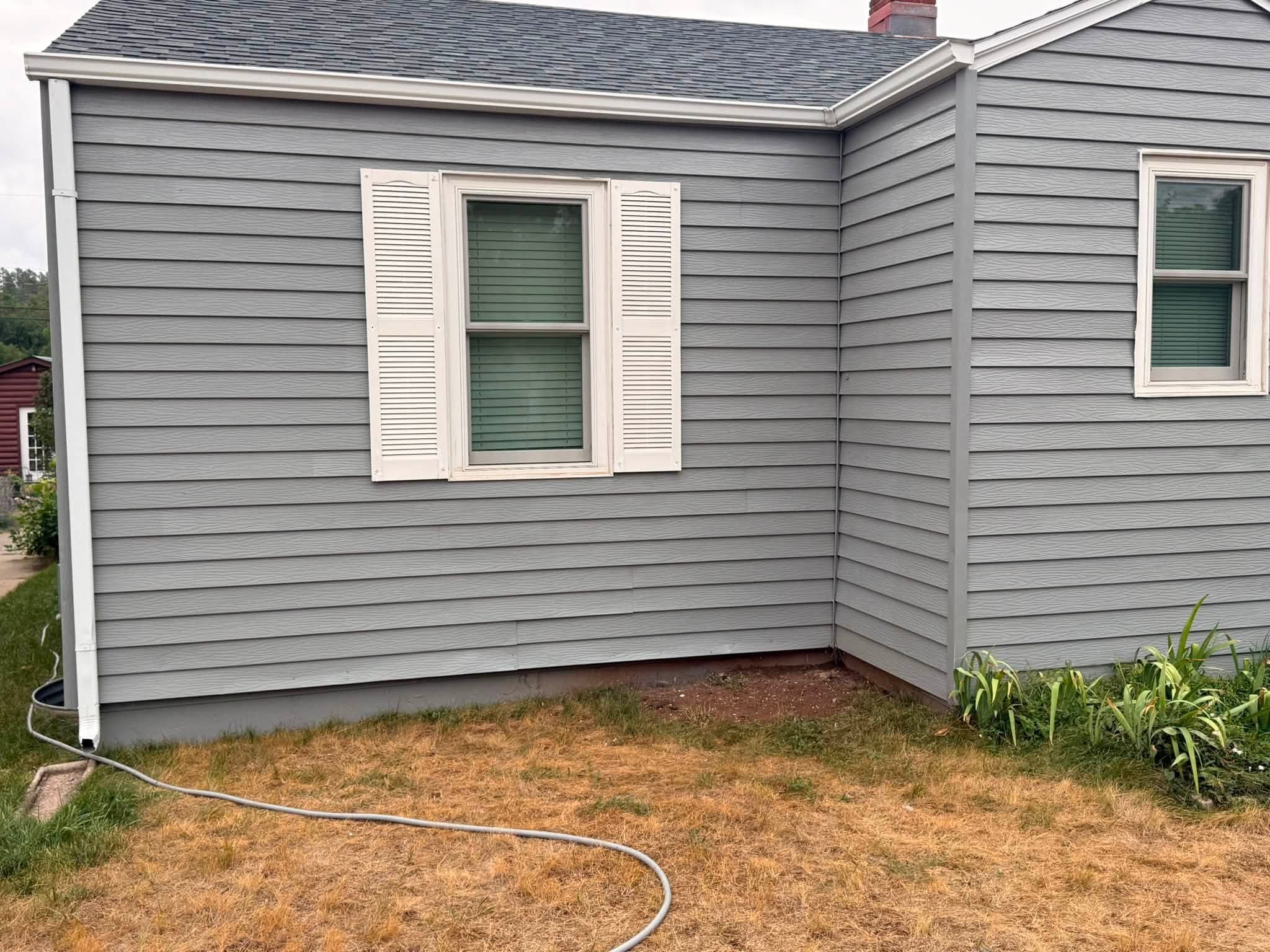
His work: one repaint carried across two elevations of the same house. Which of the two takes the afternoon sun is not recorded with the photograph — and that, rather than the paint, is what decides which of them is due first.
Strip it, or clean it and recoat?
There is a real answer to this and it takes about ninety seconds to reach. Work it in order; the first step that says strip ends the process.
1 — Put water on a dry board and watch it
This is the manufacturers’ own prep test: a few drops of water on the dry substrate. If it soaks in within seconds, the wood is open and will take a penetrating finish. If it beads or just sits there, something is still sealing the surface — and the answer to “can I stain over this?” is no, whatever the can says. Do the test in three or four places; a deck is rarely in one condition all over.
2 — Identify what is already on it
A film-forming finish sits on top — paint or a solid-color stain, opaque, and it can peel. A penetrating finish soaks in — a water-repellent preservative or a semi-transparent stain — and it wears away rather than peeling. Peeling anywhere is the tell: only a film can peel.
3 — Now the rule
- Film-forming, and peeling anywhere
- Strip. The Forest Products Laboratory: “Old varnish and paint films should be completely removed before applying stain,” and an oil-based semi-transparent stain “cannot be used on wood that was previously finished with a film-forming finish unless that finish is completely removed.” The manufacturer data sheets say it in one line as well: if general peeling is present, all previous coatings should be removed.
- Film-forming, sound everywhere, staying film-forming
- Clean and recoat. Manufacturer guidance permits recoating over previously painted or stained wood that is in good condition. “Good condition” means no peeling at all, not “mostly fine.”
- Penetrating, faded, and water soaks in
- Clean and recoat — the easy case, and the reason penetrating finishes are worth the shorter cycle. If the new stain dries with glossy patches instead of flat, it did not penetrate and it will not last; that is a prep failure showing up immediately rather than next spring.
- Semi-transparent that has started to flake
- Back to bare: the Laboratory’s instruction is that the surface must be sanded or power washed before it will take anything.
4 — Then ask whether the film should be there at all
This is the part that gets skipped. On a walking surface the Forest Products Laboratory does not treat paint as an option: “penetrating finishes, not film-forming finishes, should be used on wood decks,” and opaque stains “should not be used on structures such as decks and fences.” Railings are different — there, “paints and solid-color stains may perform quite well.” So the honest answer for a peeling solid-color deck is usually not strip and reapply. It is strip and change finish type, with the film staying on the rails where it works.
The trade-off is honest too: a penetrating water-repellent preservative has a service life of about one year on the exposed surfaces of a deck. It is a shorter cycle and a far easier one — no scraping, no stripping, and nothing to peel.
And do not let it winter over half-finished
With 6 freeze-crossing months on the calendar, a deck stripped in October and stained the following May has spent a winter with open grain taking on water and freezing it. The Laboratory’s summary of why decks die is worth reading twice: “Most decks are retired because of cracks and checks that mostly could have been avoided by timely finishing.” Strip and finish inside the same stretch of weather, or wait for one.
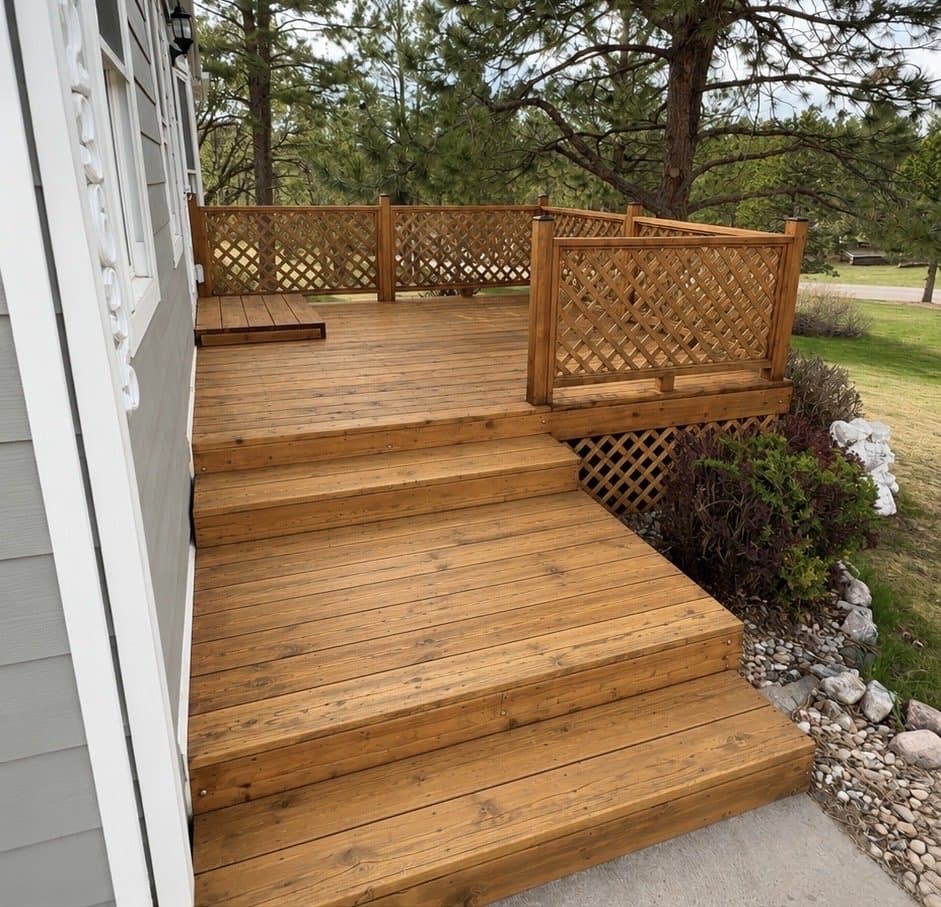
A finished deck of his — not a deck mid-strip. There is no photograph of one in the set and one will not be staged for this page. What this frame does show is a walking surface under a finish the grain still reads through.
What all of that means for booking work
The ordering falls out of the data rather than out of anyone’s preference:
- Interior & Exterior Painting — the exterior half of it lives between April and October, and only June, July and August clear the overnight bar without a forecast check. June and July then give back time to afternoon storms. The interior half has no season at all.
- Deck & Fence Staining — the same window, plus two dry days after washing before anything goes on. That is far easier to get in late summer than in the May rush.
- Drywall & Texture and Remodeling — indoor work, and therefore the sensible use of November through April, when nothing can be coated outside anyway.
None of this is a reason to wait. The prep that decides whether a finish lasts — finding the water path, opening the surface, letting it dry — is mostly weather-independent, and the good weather should be spent applying rather than discovering.
Ask what the surface is doing on your walls this week
Free Estimates. 5-Year Warranty. Locally Owned & Operated.
Rather write it out? Send the details instead.
Where these numbers come from
Climate figures are quoted, not estimated, and the classification in the month table is computed from them. Check them:
- NOAA NCEI — Monthly Climate Normals 1991–2020
Station USW00024090, Rapid City Regional Airport. Every temperature and precipitation figure on this page.
- National Weather Service Rapid City — spring freeze probabilities
Median last spring freeze for Rapid City, Lead and Custer.
- National Weather Service Rapid City — fall freeze probabilities
Median first fall freeze and first hard freeze for the same towns.
- National Weather Service Rapid City — severe weather climatology
The hail statements quoted in the June section.
- National Weather Service Rapid City — Black Hills climate
Elevation and sun intensity, and the chinook description.
- USDA Forest Products Laboratory — Finishes for Wood Decks
Penetrating versus film-forming finishes, drying time after cleaning, and deck service life.
- USDA Forest Products Laboratory — FPL-GTR-106, Selection and Application of Exterior Stains for Wood
The 50 °F coalescence requirement, orientation and sun exposure, and the strip-versus-recoat rules.
Application temperatures, the dew-point margin, dry-before-rain times and substrate moisture limits are taken from the published technical data sheets and exterior application guidance of the major North American coating manufacturers, which broadly agree with one another on these figures. They are quoted here generically on purpose: Paint & Stain Solutions is not affiliated with any coatings brand, and the numbers that govern a job are always the ones printed on the data sheet for the product actually being used on it.