

Deck & Fence Staining
Wood decides when it is ready. Stain goes on when the boards are dry enough to take it, and that is a test you can watch happen — not a date somebody picked on a calendar.
- Free Estimates
- 5-Year Warranty
- Serving Rapid City & the Black Hills
- Wood finishes
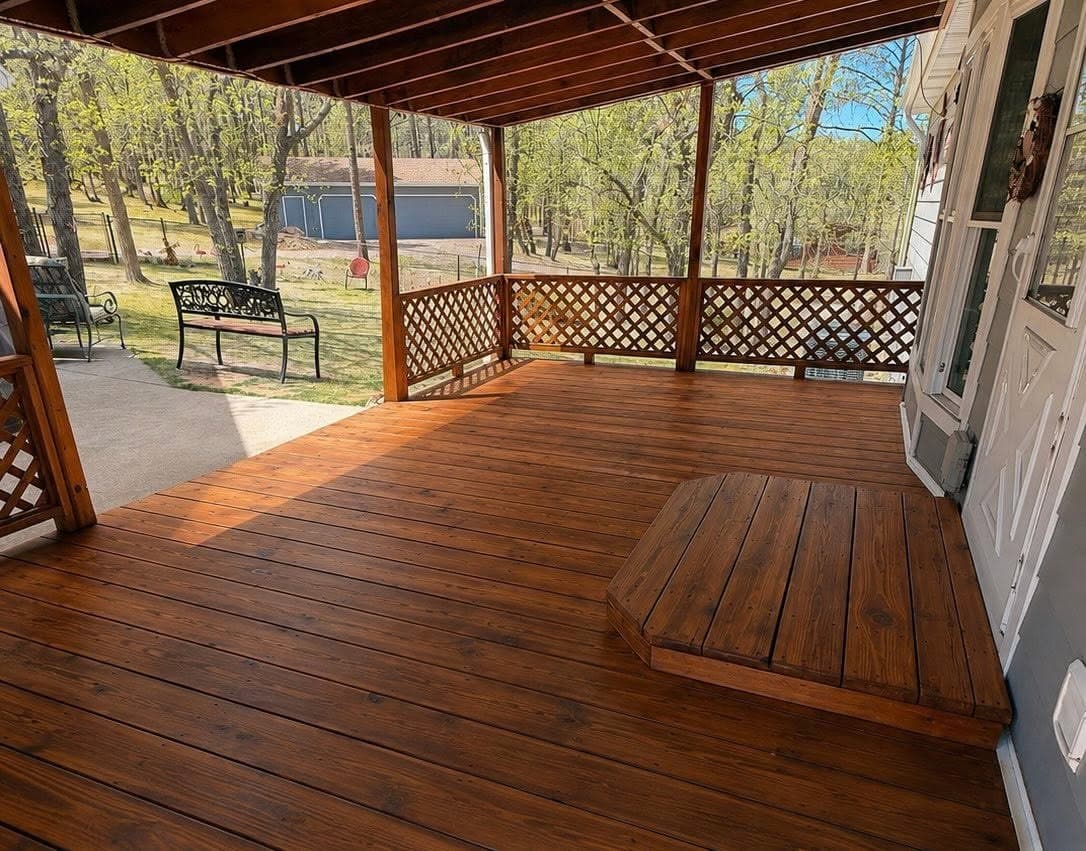
What the work involves
What’s in scope
- Deck boards, railings and stairs
- Fence panels, pickets and gates
- Posts, pergolas and exterior railings
- Recoats on wood that has faded rather than failed
Stain and paint are not the same kind of finish. A penetrating stain soaks into the wood and wears by fading; a film sits on top and wears by lifting. On a horizontal board taking full sun, standing water and snow load, a film is the harder promise to keep — and once it lifts you are stripping, not recoating.
Opacity is the real choice, and it is a trade-off with no way around it. Clear and transparent finishes show the most grain and give the least protection from UV, because pigment is what blocks UV. Semi-transparent sits in the middle. Solid hides nearly all the grain and behaves closest to paint. More pigment means more protection and less wood showing. There is no setting that gives you both.
A deck and a fence are two different problems wearing the same finish. A deck floor takes sun from above, water that sits, snow that stays, and boots. A fence takes weather on both faces and wicks moisture up out of the ground at the posts. They do not fade at the same rate and they do not come due for a recoat in the same year.
New wood is its own case. Treated lumber leaves the yard wet, and stain will not go into wood that is still full of water. The test is old and it works: flick water onto a board and watch. If it beads and sits there, the wood is not ready. If it soaks in within a few seconds, it will take stain.
On older wood the question is what is on it now. Gray is UV-damaged surface fiber, not dirt — new stain over it sits on a layer that has already let go. Mildew is alive and grows back through a coating. And a previous solid stain that is flaking is a different job from a faded penetrating one: the second gets cleaned and recoated, the first has to come off first.
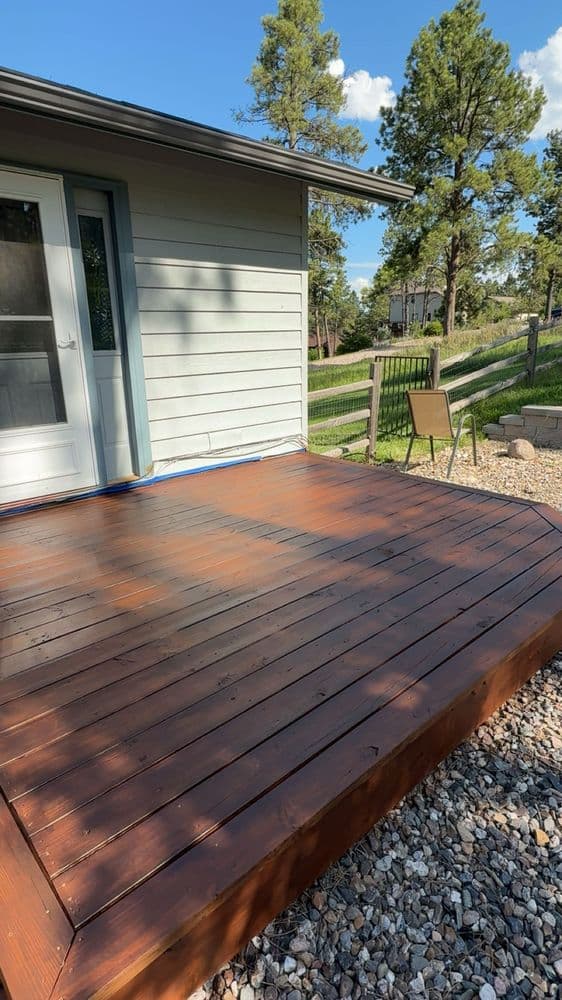
Wood prep is mostly patience
Almost all of it is waiting for water to leave. Skip that and the finish is sitting on the surface instead of in the wood, which shows up a season later and not before.
- Find out what is on it
- A faded penetrating stain and a failing film look much the same from a deck chair, and they are not the same job. This gets answered first, because it changes everything that comes after it.
- Clean it, then let it dry
- Cleaning takes off the gray surface fiber, the mildew and whatever the winter left behind. It also raises the grain and puts a lot of water into the boards — so the drying that follows is part of the prep, not a delay before it.
- Test before the first board
- Water on the wood, then watch it. Beading means the board is still full and stain has nowhere to go. This is why a deck can be ready on Thursday and not on Tuesday, and why nobody honest promises the coat before they have seen the water.
- Fasteners, splits, and the boards that are finished
- Popped nails and proud screws, split boards, soft wood at the base of a post or where a stringer meets the ground. Stain does not fix a rotten board — coating one only hides it until spring, so what gets replaced and by whom is agreed up front.
- Cover what isn’t wood, and ask the neighbor
- Siding and foundation under a deck, plants, hardware, glass. On a fence the far side belongs to somebody else, and that is a conversation to have before the first coat rather than after it.
What moves the schedule
This is the most weather-dependent work on the site. The schedule is a range with conditions attached, and a fixed date promised weeks out is a guess about the sky.
- Rain, before and after
- Wet wood cannot be coated, and a fresh coat needs a dry window behind it. A shower the night before moves the whole job — which is not the job slipping, it is the job being done in the only order that works.
- Dew and surface temperature
- Early and late in the day the boards can be cold or damp while the air is neither. Every product prints a working range, and it is the wood that has to be inside it.
- How much of it is railing
- A hundred square feet of deck floor and a hundred square feet of railing are not the same day’s work. Balusters, lattice and pickets are almost entirely edge, and edge is brushwork.
- Drying time after cleaning
- This is the step that most often decides the week. How long depends on the wood, the weather, and how much water went into it — which is why it is watched rather than scheduled.
- How much has to come off
- A recoat over a sound, faded finish is a different scale of job from taking a failed film back to bare wood. The walkthrough is where that gets established.
- New wood that is not ready yet
- Sometimes the honest answer is that the deck should be left alone for now and coated once it has dried out. That answer costs nothing to hear and a lot to ignore.
What the estimate settles
Everything above is true of this work anywhere. These are the parts nobody can answer from a photograph on a screen — they get answered on your property, with the surface in front of both of you.
- Whether this is a recoat or a strip.
- Opacity — and the color tried on your own boards, because the same stain reads completely differently on cedar, on pine and on treated lumber, and differently again on wood that has been out there a while.
- Which boards should be replaced before anything is coated, and by whom.
- On a fence: one side or both, and who is asked about the far side.
- What the water test says on the day, and the range around the start date.
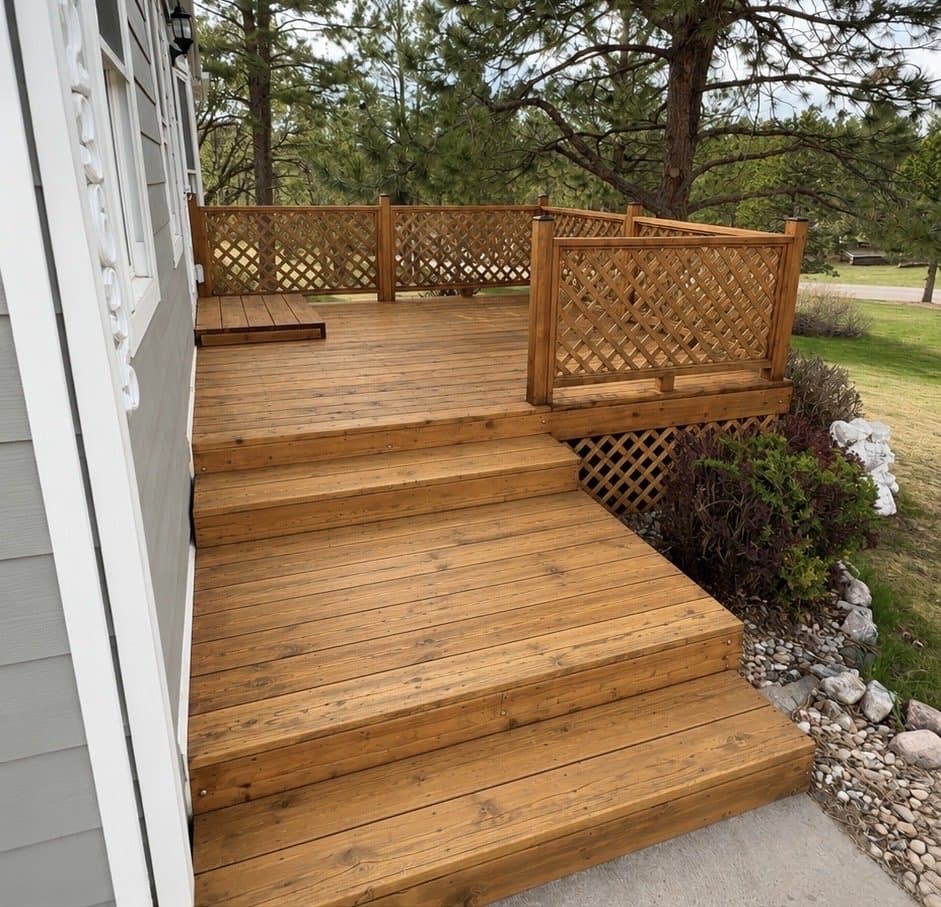
Free Estimates
Send a photo and two sentences about what you are looking at. That is enough to start the conversation — Manny comes to you across Rapid City and the Black Hills, so the next step is usually a walkthrough.
The other three
- Interior & Exterior PaintingWalls, ceilings, trim, siding — everything the light lands on, inside and out.
- Drywall & TextureBoard, tape, coat, texture — and matching what is already there so a repair stops being visible.
- RemodelingBigger jobs, where finish work is only part of it — and where a written scope is what keeps it honest.